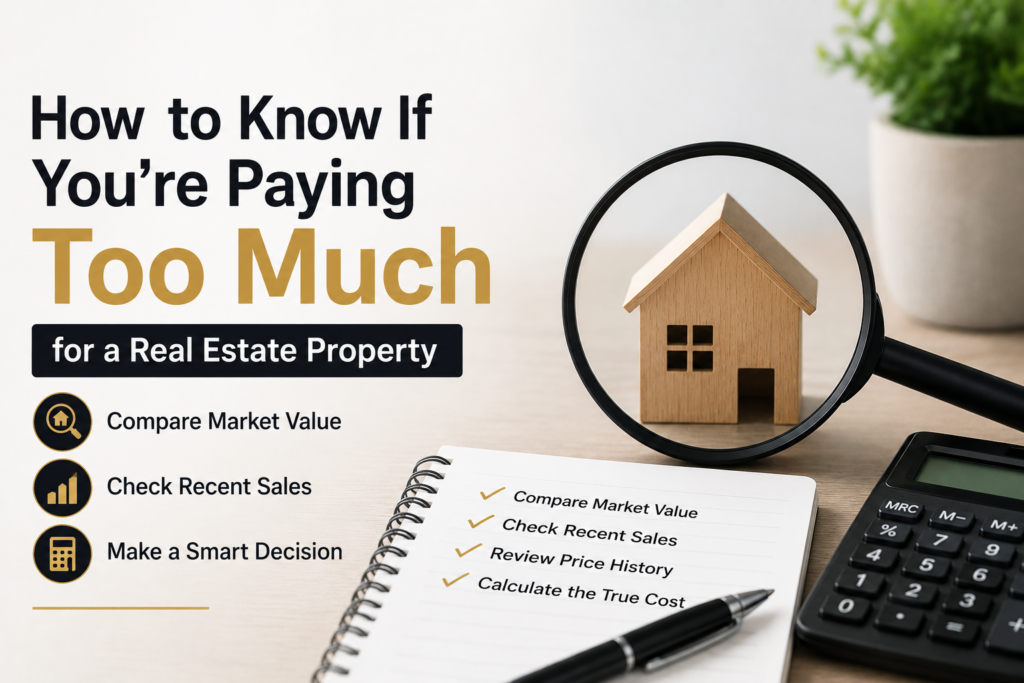
Overpaying for a property is one of the most expensive mistakes a buyer can make, and it is rarely obvious at the time. A home can look perfectly priced at an open home and still be well above fair market value once you check it against what has actually sold nearby. If you are wondering how to know if you’re overpaying for a house, the answer comes down to a handful of checks you can run before you sign anything.
Quick Answer
A property is likely overpriced if the asking price sits well above recent comparable sales and the suburb’s median, if it has been sitting on the market longer than similar listings with no offers, or if the price per square metre is noticeably higher than nearby comparable properties. Checking comparable sales, price per square metre, and days on market against local benchmarks is the fastest way to test whether a price is fair.
Key Takeaways
- Comparable sales, not other listings, are the real test of whether a price is fair.
- Days on market and price reductions are early warning signs worth checking before you fall in love with a property.
- Price per square metre lets you compare properties of different sizes on a level footing.
- Renovation costs and hidden costs can turn a fairly priced property into an overpriced one once you add them up.
- An independent property valuation or building inspection gives you a second opinion beyond the agent’s asking price.
Did You Know?
Local conditions vary sharply within the same country. In late July 2026, roughly 29% of Melbourne listings had undergone a price reduction, compared with about 12% in Sydney, according to Hamkerr’s weekly property market report. That gap is a reminder that whether a property is overpriced depends on the specific suburb and city, not a single national figure.
1. Compare the asking price with recent comparable sales
The most reliable way to test an asking price is against comparable sales and recent sales of similar properties nearby, ideally sold within the last three to six months. Focus on properties with a similar bedroom count, land size, and condition in the same or a directly comparable street. If the home you are looking at is priced well above what similar properties have actually sold for, that is the clearest sign the listing may be property overpriced relative to the local market.
2. Check the price against the suburb’s median and price per square metre
A median property price gives you a broad benchmark, while price per square metre is often more useful because it accounts for differences in property size. If a listing’s price per square metre sits noticeably above other properties sold in the same local market conditions, it is worth asking the agent to justify the gap, whether that is a renovation, a larger block, or simply an ambitious asking price.
3. Look at days on market and any history of price reductions
A property that has sat listed well beyond the typical days on market for that suburb, or one that has already been through one or more price reductions, is telling you something. Buyers before you have already decided the original price was too high. Ask the agent for the property’s full listing history rather than relying on the current headline figure alone.
4. Weigh rental yield against the purchase price for investment property
For an investment purchase, check the achievable rent against the asking price to estimate rental yield. A price that looks reasonable on paper can still be a poor buy if the rental return is well below comparable properties in the same pocket, since that gap often signals the purchase price has run ahead of what the local market actually supports.
5. Add up renovation costs and hidden costs before judging the price
A lower asking price is not automatically a good deal, and a higher one is not automatically overpriced, once you factor in renovation costs and hidden costs like stamp duty, pest treatment, or deferred maintenance. Always compare properties on total cost to get them liveable, not just the number on the listing.
6. Consider land value, location and suburb growth trends
Two homes with an identical asking price can represent very different value depending on land value, location, and suburb growth prospects. A property in a suburb with strong infrastructure spending, population growth, and constrained supply can justify a premium that would be hard to defend in a slower-moving area. Local trends matter as much as the building itself.
7. Get an independent property valuation or building inspection
An independent property valuation or thorough building inspection gives you a second, less biased view of both value and property condition. This is particularly useful when the agent’s appraisal and your own comparable sales research land in different ranges, since it helps settle which figure to trust.
8. Ask a buyer’s agent for an independent assessment
If you are unsure whether a price reflects genuine property market value, an independent property assessment from a professional buyer’s agent removes the guesswork.
Working with an experienced investment property buyers agent in Australia means someone is checking comparable sales, valuation data, and local trends on your behalf before you commit, rather than relying on the selling agent’s version of value.
Our client director, Rohit Gehlot, and the wider InvestorAid team run this exact check for clients on every property before an offer goes in, comparing the asking price against sold data rather than other listings.
FAQS:
How can you tell if a property is overpriced?
Compare the asking price against recent comparable sales, the suburb median, and price per square metre. A price that sits well above all three, combined with longer than average days on market, points to an overpriced listing.
How do I know if I’m paying too much for a house?
Check the price against genuinely comparable properties that have sold recently, not just other current listings, and get an independent valuation if the figures do not line up.
How do you determine the fair value of a property?
Fair value is best estimated using recent comparable sales, price per square metre, an independent property valuation, and current local market conditions, rather than the asking price alone.
What are the signs that a house is overpriced?
Common signs include an asking price well above comparable sales, longer than average days on market, one or more price reductions already applied, and a rental yield that looks weak relative to similar properties.
How do comparable sales help determine property value?
Comparable sales show what buyers have actually paid for similar properties recently, which reflects real market value far more accurately than a seller’s asking price or another current listing.
Should you pay the asking price for a property?
Not automatically. Whether the asking price is fair depends on how it compares with comparable sales and local market value, and in many conditions there is room to negotiate below it.
How much above market value is too much for a house?
There is no universal figure, but a price noticeably above what comparable properties have sold for in the same suburb, without a clear reason such as a larger block or major renovation, is worth questioning.
How can a buyer avoid overpaying for a property?
Research comparable sales thoroughly, check days on market and price history, get an independent valuation or building inspection, and consider an independent property assessment from a buyer’s agent before making an offer.

Rohit Gehlot is a Property Investment Strategist and Buyers Agent at InvestorAid, with over 8 years of experience in the Australian property market.
He helps investors secure high-potential properties across Australia through data-driven research, market analysis, negotiation, and long-term investment strategies.